


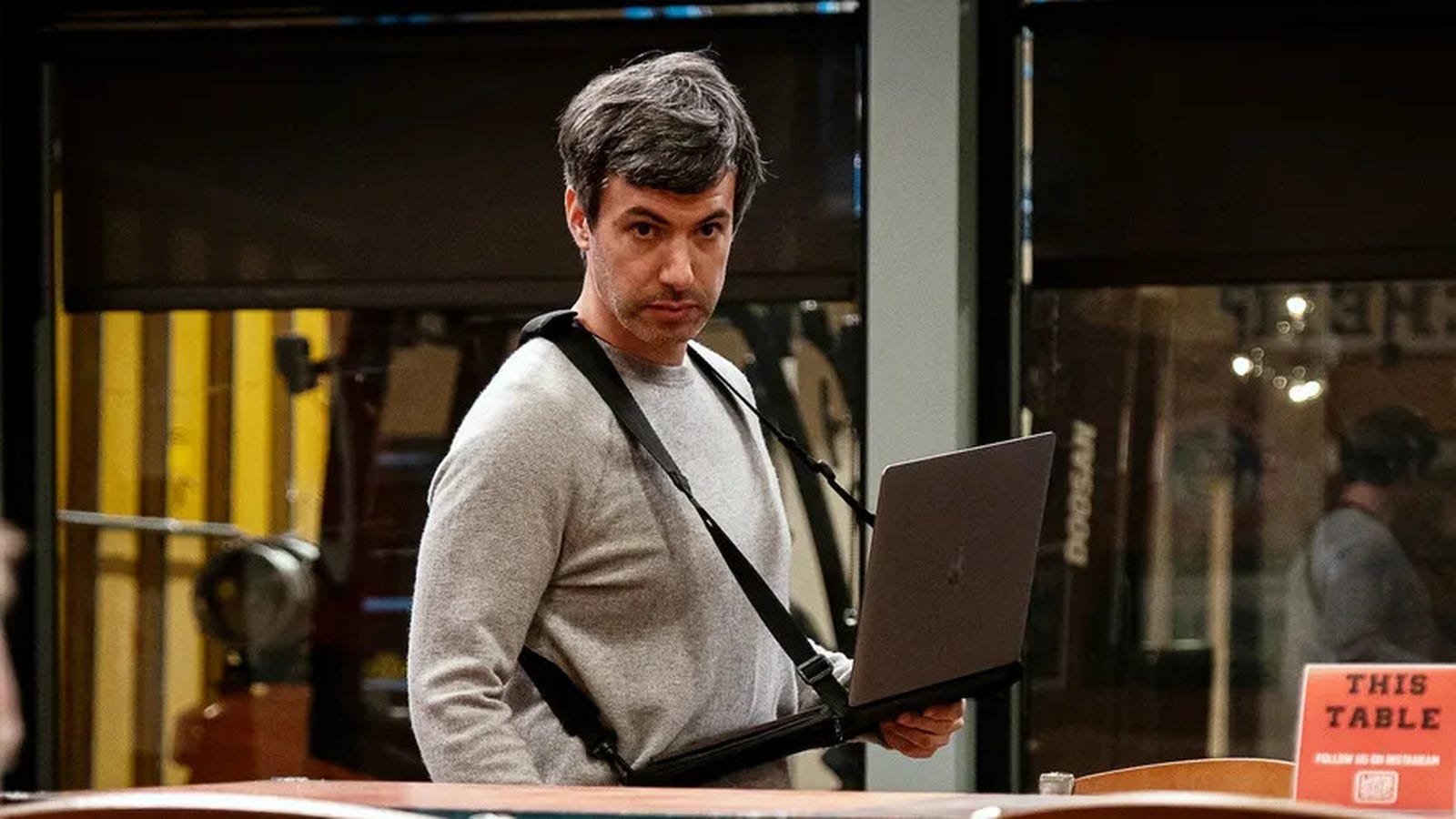
Who is this Nathan Fielder?
The Vancouver-born filmmaker, actor, and comedian has been working in various types of entertainment since 2008, when he began his career as a correspondent on CBC’s This Hour Has 22 Minutes. In high school, he was part of an improv group with fellow comedian and actor Seth Rogen before heading off to the University of Victoria in British Columbia. It wasn’t until he attended an improv course while living in Toronto that he set his path toward being the most unique mind working in Hollywood.
His big break happened in 2013 when he wrote, directed, and starred in the parody reality TV series Nathan for You on Comedy Central. Fielder uses his business background to try and pull struggling businesses out of the red with insane promotions and often incredibly expensive strategies that resemble shows like Bar Rescue or Kitchen Nightmares. Some of his episodes, like “Dumb Starbucks” where he replicated an exact Starbucks store in downtown L.A. only to be shut down three days later by health inspectors gained national attention while providing plenty of head-scratching laughs.
A perfect encapsulation of the show comes from a season three episode where Fielder creates Summit Ice Apparel. Fielder, who often uses the modern media and political landscape as a base for his ideas, decided to respond to the Canadian jacket company Taiga, which had published a tribute to a Holocaust denier. Fielder, who had worn the jacket in previous episodes and is Jewish, responded by founding the non-profit winter outdoor wear brand Summit Ice to promote Holocaust education.
His formal pitch for the clothing line includes very specific design specs and options for the brand while also sprinkling in facts about the Holocaust. Why did he choose this fight or cause? Why does he do anything he does? One thing you can credit him for is sticking to his morals. He typically responds to corporate malfeasance in the most over-the-top fashion plausible, which not only brings a company’s absurd practices to the forefront but adds in the force multiplier of media attention to cause embarrassment as well. It’s like watching prime Roger Federer work sideline to sideline, bullying his opponents into submission. Beauty in action.

His humor is completely deadpan in the most Canadian fashion imaginable. Fielder always knows his ideas and what he’s pushing go against societal norms, but the way he delivers his message to everyday people always catches them off guard. Is he crazy? Does he know this won’t work? How can I explain to this random, awkward man that this plan is completely asinine? The interactions enhance the humor, and Fielder never breaks from his resolve, bringing us to greater depths of both creativity and madness.
The Genius of Fielder
In 2022, Fielder was given a much larger budget by HBO to bring his mind to life with The Rehearsal. I’ve never seen anything put on television like this docu-comedy. It completely broke my brain regarding what could be brought to life on the small screen. The series revolves around people who have upcoming tough life conversations and may need some extra practice to garner a positive result.

To do this, Fielder constructs massive, true-to-life sets of bars, restaurants, and home spaces where the participant works with real-life actors to play out every conceivable scenario laid out in dialogue trees, leading to constant repetition. Some ideas are simple, like how to confess to a small lie, while others are as large as how to raise a child. The trained actors and level of depth Fielder brings to these scenarios are far beyond the scope of normal behavior anyone would dream to try. You constantly shake your head, wondering how or, particularly, WHY this is happening.

The series hits its stride in its second season, where Nathan explores black box airplane transcripts to see how critical mistakes in the cockpit arise, leading to fatal crashes. The pilot errors seemed to be connected to co-pilots being too intimidated or scared to speak up when the captain is putting the plane into dangerous situations. Fielder responds by making a true-to-form cockpit as well as a fully functional section of an airport, complete with stores, restaurants, and dozens of background actors to play out where this disconnect between pilots is occurring.
This leads up to the greatest story arc I’ve ever seen on TV, where Fielder replays the life and events of the “Hero of the Hudson,” Sully Sullenberger, which he could then replicate with other pilots in the future to save lives.

Fielder represents Sully as a baby being breastfed by a gigantic marionette mother. Following scenes showcase his emotionally isolating family upbringing, quirky love interests, and how a late midlife crisis venture into the Evanescence hit “Bring Me to Life” was the key to saving hundreds of souls aboard that fateful day. It was complete insanity for an hour, leaving me on the edge of my seat laughing and in complete wonder at how his brain works.
Fielder’s ability to bring absurd ideas to fruition is his calling card. He knows exactly how his conceits will be viewed by the public and the reactions they will cause. He sees the humor in his delivery and the awkward nature of the human condition, using it to his advantage. It’s nothing short of extraordinary how he chooses to attack the conventions of storytelling by making them larger than life. No one in Hollywood has a brain that sees things quite the way Nathan does, and that brings us to his next venture, which comes out this weekend: the documentary You Can See Everything.
You Can See Everything
In a nutshell: Elizabeth Holmes was America’s youngest self-made billionaire when her health technology company, Theranos, hit the market with the promise of being able to screen for hundreds of diseases with just a single drop of blood. This would have revolutionized the market, but the only snag was that the technology didn’t work. She, along with her COO boyfriend Sunny Balwani, raised over $700 million from investors while lying to them about the true efficacy of the research. After various federal cases, the courts sentenced her on fraud charges to 11 years in prison and over $450 million in restitution to their investors.
Holmes, living with her new partner and hotel heir Billy Evans, had just welcomed their second child as she awaited the date to turn herself in to begin her long prison bid. They wanted to have someone with an outside-the-box thinking mind to document their last month together in the hope of uncovering new truths that would shed a different light onto her vilified persona. There have been countless exposés, investigative shows, and even a Hulu Emmy-winning series, The Dropout, that recount her actions which led to Theranos’s downfall. Holmes and her family feel she’s been wronged by the media and decided that Nathan Fielder would be the best person to document this story leading up to her first day in the clink.
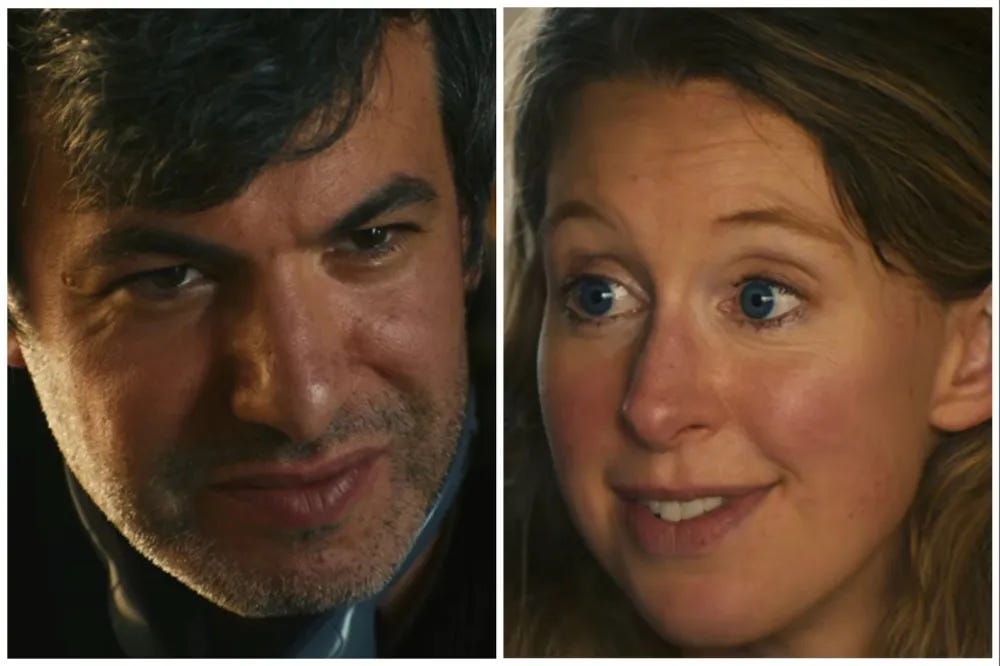
Time is money, why should I go?: The idea that Elizabeth and her partner Billy have in mind versus what Fielder and Oppenheimer want to convey with this documentary is a Venn diagram that doesn’t always overlap. The subjects want Fielder & Co. to display the family-life persona to combat their negative image while also trying to dive into the innocence of Elizabeth regarding her charges. Nathan is much more interested in understanding what makes Holmes tick and the dynamic that she shares with her oddly dominant husband, Billy. We see the Hawthorne effect over thirty days as Fielder tries to break through the iron veneer that Holmes puts out to the world. Holmes portrays her innocence through and through with specifics on her case and interactions with investors. She truly believes herself—or at least WANTS to have those feelings when you watch. Sifting through the bullshit is what Fielder wrestles with throughout the three-hour runtime.
As the filming moves closer to her prison sentence, we see Elizabeth and Billy trying to push Theranos 2.0 by selling their new vision of the failed product and once again bringing in big-money investors. They insist that her device, while failing at first, was something that would need many versions to get correct, which is very true in theory. However, when millions (potentially billions) are on the line, they should be less flippant about what’s at stake.
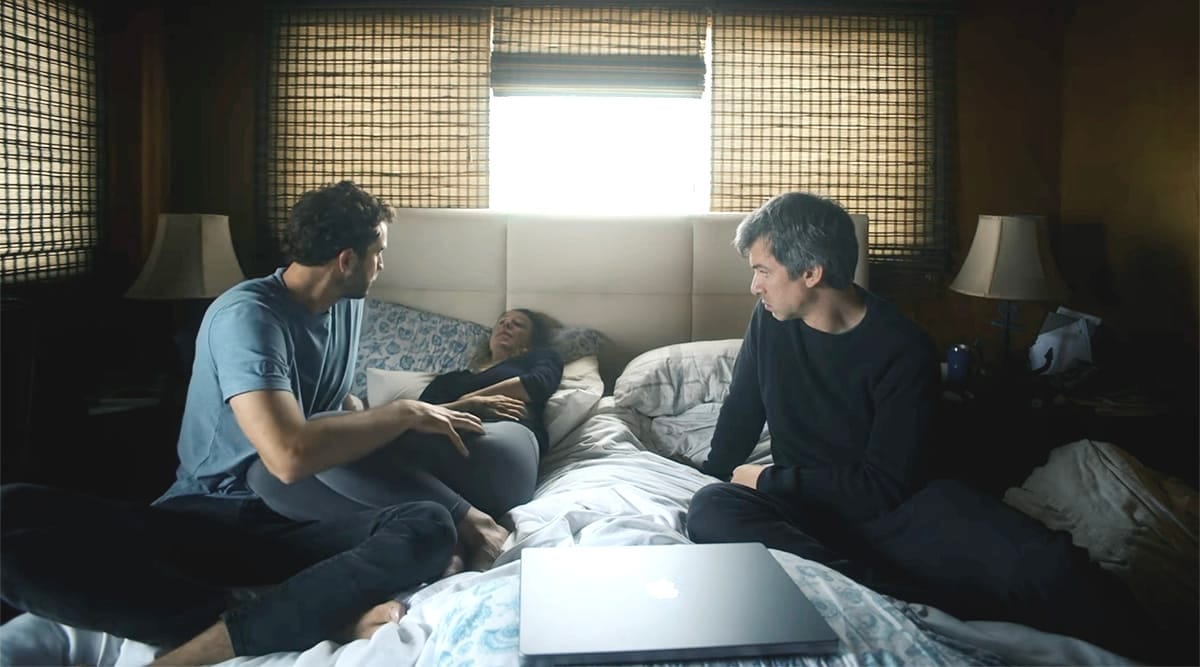
I can’t talk about the genius of Nathan Fielder without mentioning his classic spin on the genre. He wouldn’t take on this project without the ability to create a spectacle that everyone who’s seen his prior work knows is coming. I won’t give too much away, but there are several conversations and correspondences that couldn’t legally be caught on film or they would violate several laws surrounding her case. So Nathan does what he does best and recreates these critical points in the story with his own narrative spin. I never once checked my watch, and the last hour is completely spellbinding.
Star of the show: You can make a case for Fielder lurking around, asking the perfect questions which can draw a laugh and make you ponder, and being the lone sane person in the documentary. Elizabeth is an enigma whose brain seems impenetrable, leaving you to doubt your feelings on her constantly. The real answer here is her husband, Billy.
Billy is independently wealthy and secretly a right-wing tech bro who would probably say he’s just “libertarian” in spirit. He fully knows of his partner’s inability to stand up for herself in prior relationships but has zero problems talking FOR her at any point through the three hours. So much so that she signs away her Power of Attorney before heading into prison so he can legally speak AS her, claiming that “they share the same soul” and thought processes. The man, much like his partner Elizabeth, showcases true sociopathic tendencies that grow the more we are exposed to them.
Best 5-minute stretch: Nathan notices Elizabeth has a tough time in her choice of delivering phrases which she believes to be true but come off to the general public as lies. She truly believed her machine did what it was capable of doing and kept its promise when investors and the courts say otherwise.
To give her an analogy he feels makes sense Nathan shows her the classic Abbott and Costello skit “Who’s on First?” to symbolize how linguistic double entendres can be misinterpreted. Not only does Elizabeth not understand the main premise of the skit but after prying deeper she comes off as completely detached from simple conversational norms. This makes you question even more if she actually believes she is innocent or not. It was baffling and also made a lot of sense.
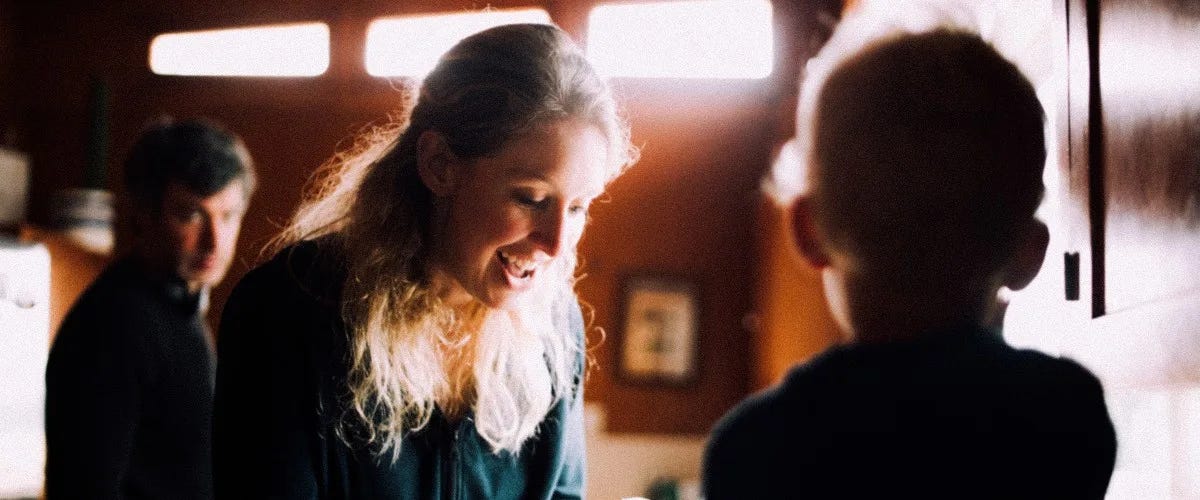
30-second timeout: I can’t make heads or tails of Elizabeth. I believe she thinks very differently but also knows exactly how she is perceived. She uses these perceptions to deflect culpability and defend her innocence. She also is about to leave a young infant as well as a two-month-old baby for over a decade and has to wrestle with this realization while it’s captured on camera. The documentary makes you feel her plight while also wondering if she’s secretly an awful person. I teeter-tottered for about half the film before coming to a decision myself, but that’s the best part about a great documentary: you choose your own adventure.
Don’t Sleep On: Co-director Lance Oppenheim is riding high from the success of his most recent film still in theaters, Primetime. After making his feature-length directorial debut, Oppenheim teamed up with Fielder to go back to more familiar documentary territory. The choices made to use intense, up-close camera work and keep long stretches of uninterrupted silence through various exchanges were successful on so many different levels. The editing choices and additions of extra recreated scenes gave this documentary a fresh take while still not taking us out of the bigger story. I can’t wait to see what both Oppenheim and Fielder have coming down the pipeline.
MatM Score: Highly Recommend - 9.5 (A reinvention of the genre featuring true sociopaths)